From trade theatrics to household survival — rebuilding Canada from the ground up
Dear Premiers and Prime Minister,
TL;DR — The tariff war isn’t Canada’s crisis — it’s just the symptom.
While premiers and Ottawa have poured millions into ad wars, tariff theatrics, and diplomatic flattery, Canada has been collapsing at home. Food insecurity, shelter stress, and land inequality have all hit record highs.
This isn’t about one bad week in Washington. It’s about four decades of mercantilism—measuring success by exports and foreign approval while ownership and livelihood slip from Canadian hands. The cure is not better PR or bigger bailouts. It’s distributism: widespread, household-scale ownership of productive land and tools, governed at the nearest competent level. When families can feed, heat, and house themselves, trade headlines lose their power over our peace.
🧱 How our leaders helped build this trap
While the public tightens belts and wonders how to buy groceries, Canada’s premiers and Ottawa have spent the year playing tariff theatre — shuffling blame while every province sinks deeper into dependency.
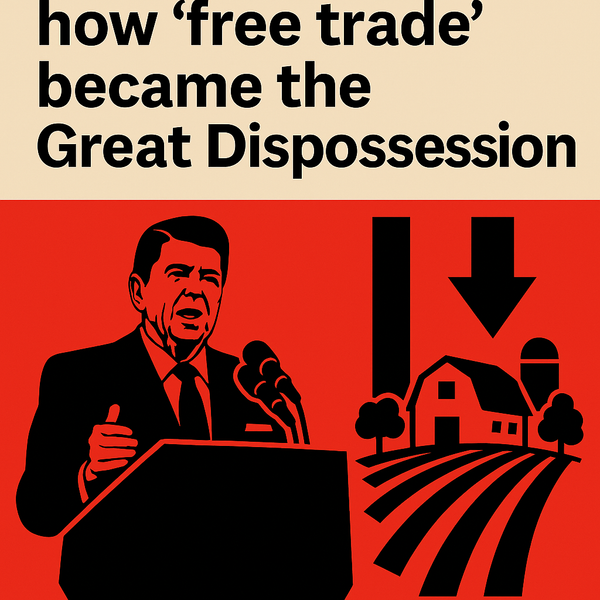
Ontario’s $75-million Reagan ad wasn’t strategy; it was spectacle — a stunt that cost us the last thread of negotiation with our largest neighbour. Alberta’s pitch to “keep oil flowing” promised calm to investors but chained our economy tighter to a fuel that no longer feeds us. British Columbia and Québec mirrored Ottawa’s counter-tariffs and photo ops without addressing local self-reliance; Saskatchewan courted Beijing to replace Washington, trading one master for another. Manitoba, Nova Scotia, Newfoundland, and New Brunswick made gestures — removing U.S. liquor, raising tolls, drafting “plans” — but no one offered a path to feed or house their own citizens if global markets falter.
The Prime Minister, for his part, has managed optics rather than ownership — alternating between hard talk and appeasement while the real economy frays beneath him. Every premier has done the same within their borders: retaliate, advertise, and reassure, but never re-root.
Together, you have built a politics that treats the country as a brand to defend, not a home to secure. The result is a federation dependent on foreign capital, foreign food, and foreign fuel — a nation that cannot act freely because it cannot feed itself.
You all helped build this trap. Now you must help dismantle it. The repair cannot come from Washington, Beijing, or Bay Street. It begins where all sovereignty begins: with land in the hands of the people who live on it.
Before any of you draft the next statement or tariff response, look at the country you are governing. The damage isn’t theoretical or partisan — it’s measurable, and it’s already here. The following data points come from Ottawa’s own agencies: Statistics Canada, CMHC, NRCan, Finance Canada, and AAFC. Viewed together, they show what your offices have failed to: that Canada’s social and economic foundations are breaking beneath the weight of dependency.
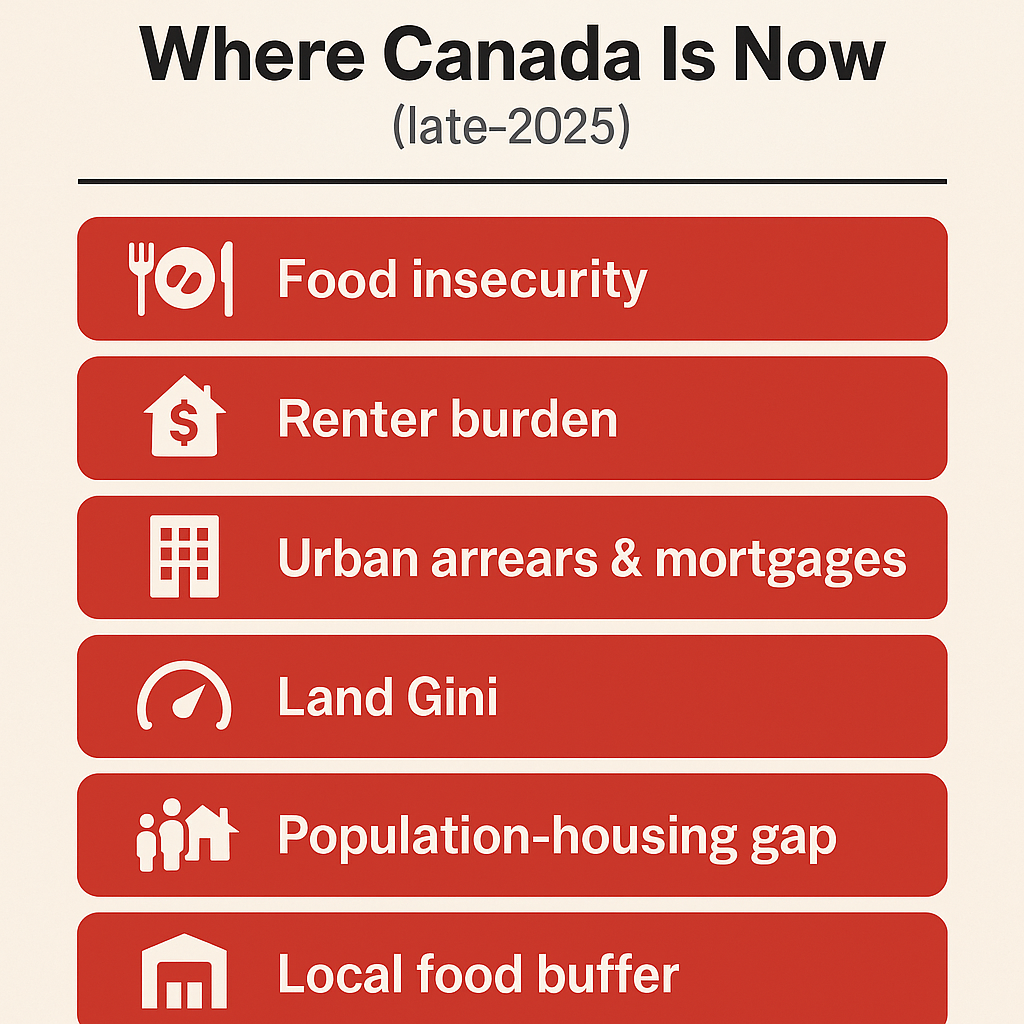
Where Canada is now (late-2025, with sources)
The following 13 indicators are drawn directly from Ottawa’s own statistical agencies — Statistics Canada, CMHC, NRCan, Finance Canada, and AAFC — yet they are never viewed together. When assembled as a single dashboard, they reveal a nation already in structural strain, even as headline GDP and CPI still appear “green.”
These measures are not arbitrary; they align closely with the internationally recognized foundational resilience frameworks used by the OECD, United Nations, World Bank, and FAO:
| Global Reference Framework | Corresponding Indicators in Canada’s Dashboard |
|---|---|
| OECD Better Life Index / Well-Being Framework | Housing affordability, income inequality, civic engagement |
| UN Sustainable Development Goals (1–12) | Poverty, hunger, energy, infrastructure, and land-use security |
| World Bank Household Resilience Framework | Food-expenditure share, housing burden, access to energy, asset ownership |
| FAO Food-Security Pillars | Availability, access, utilization, and stability — proxied by food insecurity rates, diesel/fertilizer costs, and local food-buffer capacity |
Indicators:
| Indicator | Current Reading / Source | Interpretation & Reason for Colour | Status |
|---|---|---|---|
| Food insecurity (HFSSM) | 25.5 % of Canadians (≈ 10 million people, incl. 2.5 M children) lived in food-insecure households in 2024. — Statistics Canada | “Severe” food insecurity above 20 % is associated with population-level malnutrition and social unrest (FAO, WHO benchmarks). At 25 %, Canada is well past the red line. | 🔴 Critical |
| Food share of disposable income (national avg.) | ≈ 10.7 % (2024) — Canadian Federation of Agriculture / CFA Food Freedom Day report | < 15 % = normal. However, this average hides inequality; bottom-quintile households spend ≈ 28 %. National mean looks green, lower-income reality does not. | 🟢 (average) / 🟡 (low-income) |
| Households paying ≥ 30 % on shelter | 22 % overall (2021) — owners 16.1 %, renters 33 % (Century Initiative from Census 2021) | CMHC defines “core housing need” as ≥ 30 %. When ≥ ⅓ of renters exceed that line, the housing system is in stress. | 🟢 overall / 🔴 renters |
| Rent arrears (purpose-built rentals) | 7.8 % nationally (2023); 19.6 % in Toronto — OECD 2025 summary of CMHC data | < 5 % = healthy; 5–10 % = strain; > 10 % = distress. Most metros now at or above yellow; Toronto deep red. | 🟡 avg / 🔴 metros |
| Mortgage carrying cost (RBC Affordability Index) | 55 % Canada, 86 % Toronto, 131 % Vancouver of pre-tax median income (Q1 2025) — RBC / CMHC | < 40 % = affordable; 40–60 % = strained; > 60 % = unsustainable. After-tax costs are worse. | 🟡 national / 🔴 metros |
| Rents vs. wages | CMHC Fall 2024 report: rent growth > wage growth for core-age renters; arrears still elevated. | When rents grow faster than wages for > 2 years, purchasing-power erosion = yellow. | 🟡 |
| Diesel price (freight proxy) | ≈ CA $ 1.50 / L (Oct 20 2025) — NRCan via GlobalPetrolPrices / Wikipedia | < 1.25 = normal; 1.25–1.75 = strain; > 1.75 = crisis. Freight and farm costs stay high. | 🟡 |
| Fertilizer pressure | Eastern Canada prices ≈ 30 % above New Orleans benchmark since 2022 — Grain Farmers of Ontario briefing, Jun 2024 (Link2Build) | Fertilizer-to-crop price ratio > 1.3× 5-yr avg = warning; > 1.5× = red. High input costs risk lower planting. | 🟡 |
| Population vs. housing production | Population +1 M (2023) vs ≈ 245 k housing starts (2024) — Statistics Canada | Net immigration ≈ 5× new units → supply shortage drives rents and prices. Persistent gap = red. | 🔴 |
| Human-owner share of titles (est.) | ≈ 70 % natural persons vs 30 % corporate/foreign (StatsCan & provincial registries 2023). | > 80 % = healthy; 70–80 % = warning; < 70 % = concentrated. | 🟡→🔴 borderline |
| Land Gini (ownership inequality) | ≈ 0.80 (StatsCan farm and residential land distribution 2023). | < 0.65 = balanced; 0.65–0.75 = unequal; > 0.75 = concentrated ownership. | 🔴 critical |
| Local calorie buffer | < 1 week for most urban CMAs — AAFC logistics studies. | Food-security planning standard = 3 weeks per capita; < 1 = critical. | 🔴 critical |
📊 Summary (refined)
Out of 13 key indicators:
- Green (secure): 1 (≈ 8 %) — only the national food-share average.
- Yellow (strain): 5 (≈ 38 %) — bottom-40 % food costs, diesel, fertilizer, rents vs wages, ownership share.
- Red (crisis): 7 (≈ 54 %) — food insecurity, renter burden, urban arrears & mortgages, land Gini, population-housing gap, local food buffer.
Why Ottawa can’t see what every household feels
This blindness isn’t personal; it’s structural. Ottawa’s economic machinery was built for PR stability, not household reality.
- Metric capture. Every major indicator — GDP, CPI, “affordability” ratios — is designed around aggregate flow, not distribution. When corporate profits and high-income consumption stay strong, the averages glow green even as half the country bleeds red.
- Institutional incentives. Ministries and central agencies are rewarded for calm markets and investor confidence, not for falling food insecurity or rising land access. A red dashboard spooks bond buyers, so the dials are set to optimism.
- Time lag and political optics. Most data arrives 12–24 months late. By the time a crisis appears in print, it’s already yesterday’s problem — perfect for press conferences, disastrous for households.
- Urban abstraction. Decision-makers live inside the capital’s bubble: stable salaries, subsidized mortgages, and secure pensions. Their lived inflation is 5 %, not 25 %.
The result is policy myopia — a system that confuses the health of balance sheets with the health of citizens. Ottawa hasn’t consciously chosen deceit; it has simply outsourced perception to aggregates. And aggregates cannot feel hunger, eviction, or heat bills.
⚠️ The cost of believing the mirage
Ottawa’s dashboard still flashes “green,” but that’s a statistical mirage — and every government that has believed such mirages has fallen.
The national indicators are engineered to smooth pain into averages: high earners dilute hunger, rural affordability offsets urban collapse, and quarterly GDP growth masks household insolvency. On paper, the nation looks calm. In real life, one in four Canadians skips meals, one in three renters spends over 30 % of income on shelter, and the next generation cannot afford a roof or an acre.
When this many signals go yellow and red at once — food insecurity above 20 %, shelter burdens above 30 %, ownership inequality above 0.8 Gini — history offers only one outcome: political rupture.
- Britain’s 1970s stagflation: energy squeeze + rent burden + official denial → Winter of Discontent.
- Arab Spring (2010–11): food prices exceeding 40 % of household income toppled regimes.
- Chile & Sri Lanka: fuel and food inflation beyond 30 % of income triggered unrest and fiscal collapse.
- France’s gilets jaunes (2018): began not with ideology but with diesel at €1.50/L — the same level Canadian farmers now face.
These are not distant curiosities; they are case studies in what happens when elites trust aggregates over appetite.
Ottawa’s “green” dashboard is not reassurance — it’s camouflage. It measures trade throughput and corporate profit, not whether families can eat, heat, or stay housed. A government that governs by those dials will see stability on its spreadsheets right up until it loses legitimacy in the streets.
If the federation’s leaders will not recalibrate the instruments — to track food, shelter, energy, and land security for ordinary households — the correction will come by harder means: arrears, unrest, and provincial fracture.
The choice is simple: change what you measure now, or be measured by the consequences later.
What’s actually wrong (plainly)
Root cause: mercantilism hollowed ownership.
For four decades we measured prosperity by trade flows and corporate deals while ownership concentrated and household resilience withered.
- Brittle dependence: survival tied to distant elections and boardrooms.
- Price-taker trap: we export inputs, import finished value; wages stall.
- Theatre over substance: money to PR and lobbying instead of barns, mills, and shops.
- Landless citizens: without land and tools, people become renters in their own economy.
- Perpetual anxiety: a province with few owners has many crises.
Markets can ignore tariffs; families cannot ignore rent, debt, and lost farms.
The myth of the housing bubble as national backbone
Many now believe that Canada’s stability rests on inflated property values—that we are, in effect, on a “mortgage standard.” This is not strength; it is collective fragility disguised as wealth.
Rising prices have never built a home—only debt. The average house price tripled in twenty years, yet home ownership fell and mortgage risk ballooned. The illusion of prosperity depends on keeping younger generations out. That is not a foundation; it is a Ponzi scheme built on family displacement.
If prices correct, the paper wealth vanishes—but the land remains. The soil does not crash, the forests do not default, the rivers do not foreclose. What vanishes is the fiction that a nation can mortgage itself into safety. When homes are valued for shelter and stewardship, not speculation, the real economy—food, energy, craft, care—can finally breathe again.
Constructive pivot (nationwide, provincial-led)
Canada already has what matters: land, water, skill, neighbours. Let trade carry surplus; let subsistence and essentials come from home.
Nine measures you can move on this year
- Human-only freehold. Title held by natural persons; corporations/funds lease, not own. Launch a public beneficial-ownership registry to end land hiding.
- Open homestead clusters (3–6 ha) on Crown land near existing roads/hamlets; 3 years’ residence → patent.
- Unlock over-large private holdings. Permit 1/3/6-ha severances near settlements; list to eligible human buyers with cap checks at closing.
- Caps & turnover. Personal cap ≈ ≤10 ha/adult (higher only for bona fide co-owned households). Vacancy levy → mandatory lease-out or sale after a grace period.
- Whole-Homestead Affordability metric. Track land + modest dwelling vs regional incomes; when above target, auto-trigger more severances, new clusters, fee relief, and fast-track simple rural builds.
- Make local legal. Cottage-food, micro-dairy, farmgate meats, mobile abattoirs, inspected community kitchens; proportionate insurance and code.
- Guilds & co-ops first. Procurement preference within 200–300 km for worker co-ops and small shops (mills, tanneries, saws, machine shops, canola crush, wool scouring).
- Seed & skills commons. Provincial seed banks (open-source varieties), county soil schools, and apprenticeships so every household has land, seed, and know-how.
- Fund production, not PR. Reallocate ad budgets to homestead starts, mobile abattoirs, co-op mills, rural clinics, and short-line rail.
Indigenous partnership, not tokenism. Honour FPIC for any openings within title/treaty areas; enable nation-led homestead programs with equal standing; share revenues and co-manage range, water, and forestry. Reconciliation through shared stewardship, not slogans.
Automatic levers when the lights turn red
Pre-commit non-discretionary actions tied to public dashboards (county/CMA level). No committees—automatic triggers:
- Bottom-40% food+heat share ≥ 35% for 2 quarters → release clustered Crown homesteads; permit rural severances; reduce rural development charges; fast-track code-compliant cabins/tiny/natural builds.
- Severe food insecurity rises (≥ 20% and climbing) → purchase to 3-week local calorie buffers (grains/beans/potatoes) and stand up public/co-op markets.
- Human-owner share < 70% or Land Gini > 0.75 → activate vacancy levies, mandatory lease-out of idle parcels, and full beneficial-ownership disclosure/enforcement.
- Freight diesel or fertilizer index spikes (≥ yellow band sustained; ≥ red acute) → prioritize rail corridors for food, fund greenhouse heat loops, launch municipal compost→fertilizer programs. (Diesel ≈ CA$1.50/L, NRCan weekly series, Oct 20, 2025.)
Provincial mirrors (Alberta as example—applies everywhere)
Alberta shows some of the highest land disparity and exposure to freight/fertilizer shocks. That’s an Alberta problem to fix—no scapegoats required. The province’s future doesn’t depend on trade favours; it depends on being kind enough to one another to guarantee the essentials of life: land, seed, and the know-how to make them fruitful. The same mirror belongs in every province.
100-day starters
- Table human-only title and beneficial-ownership bills.
- Identify 3–5 homestead clusters per province (Crown land with road access).
- Issue right-sized rules for cottage-food, micro-dairy, mobile abattoirs.
- Launch the Whole-Homestead Affordability public dashboard.
- Announce a co-op procurement preference within 200–300 km.
- Convene a Subsidiarity & Stewardship Working Group with Indigenous leadership to coordinate pilots and share templates.
Federal facilitation (no new megaprograms)
- Harmonise beneficial-ownership data; enforce anti-hiding rules.
- Align CMHC/Building Code to support modest rural dwellings where safe.
- Remove frictions to interprovincial sale of small-scale foods and crafts.
- Back short-line rail and rural broadband that strengthen regional markets.
North Star metrics (publish quarterly, county-level)
- % of households able to secure a home-with-land at ~3–4× income.
- Bottom-40% food+heat share (target < 25%).
- Severe food insecurity (falling).
- Human-owner share of titles (rising) and Land Gini (falling). (If not available, build the registry and publish it.)
- Weeks of local calorie buffer (≥ 3 weeks per capita).
- Share of staples produced within 200 km (rising).
- Ownership cost index in major CMAs (falling toward yellow/green).
- Rent arrears (falling).
We can end the “us vs. them” spiral. We’re all Indigenous to the same Earth, and every person deserves enough land for subsistence. Unite the country around stewardship and widespread ownership, and the tariff cycle will lose its grip on our peace.
“They shall sit every man under his vine and under his fig tree, and none shall make them afraid.” — Micah 4:4
“Those humans who have flourished upon third-density Earth and who began as part of the balance of life have forsaken the concept of stewardship and have replaced it with the concept of predation.
When a kingdom is put into the power of a steward, the steward looks at each part of his realm and finds ways to support and sustain it… not greater than the sheep, but the servant of the sheep.
…Consequently, there is also a substantial list of species that have declined and become extinct because of the lack of stewardship and the ascent of predation on the part of the humans to whom Mother Earth was entrusted.
We would encourage you, as you think in this regard, to focus not upon the details of one species becoming extinct, but upon the energies which you radiate personally…
One person waded out into that beach and started throwing starfish back in the water. A scoffer said, ‘You can’t possibly save all the starfish.’ And the entity picked up a starfish and tossed it into the water and said, ‘Yes, but I can save this one.’”
— Q’uo, December 19, 2009
Each of you holds some piece of stewardship — a jurisdiction, a province, a trust. You cannot save the whole system at once, but you can save your part of it: a farm revived, a family rehoused, a town re-rooted in its own soil. Every acre returned to human hands, every co-op or cottage industry revived, every local law re-written for sufficiency rather than spectacle is one starfish thrown back into the sea.
There is still time to act before necessity chooses for us. The measures in this letter are not radical—they are remedial. Begin them now, while consent still exists and peace can still be kept.
May you be blessed,
Andrii Zvorygin
Owen Sound, Ontario, Canada