Grey County: Building Resilience for Families and Farms
Through you Honourable Warden Andrea Matrosovs,
First, respect where it’s due. Grey County runs tight but steady: roads are maintained, water is safe, EMS meets targets, and planning stays on track. The most heroic work is at the front line. Our housing and homelessness staff, and the teams running community meals and outreach, are serving more people with fewer resources, day after day. They treat neighbours with dignity, keep families together when they can, and make sure no one is left unseen. Their example is our foundation and our call to plan ahead.
While we acknowledge with gratitude the Province’s continued funding—such as the recent $20.7 million OMPF investment across Bruce–Grey–Owen Sound—we want to express our sincere appreciation. These funds keep our essential services running: roads maintained, bridges safe, emergency services equipped, and municipal operations stable. Grey County depends on this partnership, and we’re thankful for the Province’s continued commitment to supporting rural and northern communities.
That said, higher governments—both federal and provincial—remain focused on courting global capital and major corporations rather than strengthening the position of ordinary Canadians. There is still no coherent plan to help people own land, build food reserves, protect working soils, or secure planting-season fuel. As energy tightens and ownership concentrates, policies continue to serve investors first, citizens second. The national conversation has shifted from affordability to ration-style programs such as expanded school lunches—well-intentioned and essential for children today, but no substitute for rebuilding regional production, local ownership, and true resilience.
Two hard trends are driving the crunch:
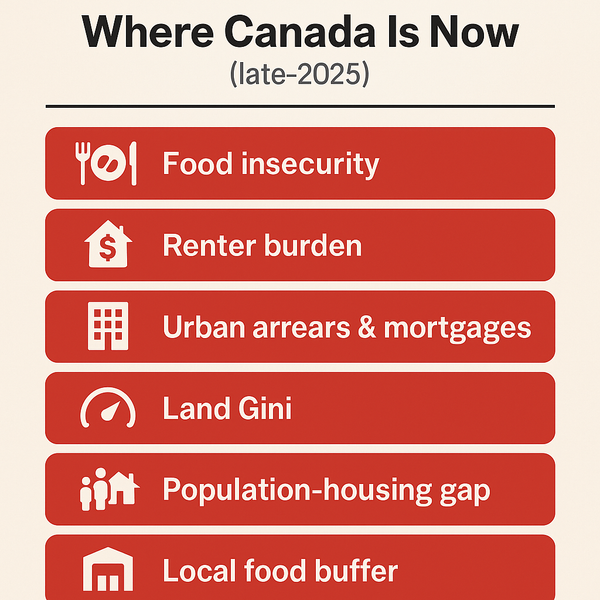
- Food insecurity is rising ~4 percentage points per year.
- Land consolidation is rising ~2% per year.
If we wait, those lines cross into a brittle system. When more neighbours skip meals, they won’t go to Queen’s Park or Ottawa—they’ll come to City Hall. Our duty is to be ready.
Our response: honour staff while upgrading policy. We’ll move calories closer to home and build the simple infrastructure that makes hardship survivable: mills, cold rooms, local depots, a planting-season fuel corridor, and voluntary urban-to-rural paths through a community land trust. We’ll publish a quarterly dashboard (stocks, hectares planted, fuel status, service levels) so everyone can see what’s real.
If we leave the status quo in place
What drives it: tightening fuels, 4-point annual rise in food insecurity, 2% annual rise in land concentration, long supply lines, and no serious stockpiles or fuel corridors.
How bad can it get, and when? (risk-banded—not prophecy)
2026–2030 · High stress, still reversible
- Food-insecure households: 28–35%.
- Diesel tight at planting/harvest in some regions.
- Forced sales rise as land stays mispriced vs farm cashflow.
- Trajectory: ration programming expands (school meals, voucher cards); child malnutrition flags begin to climb.
2030–2035 · Systemic brittleness
- Food-insecure: 35–42% (kids 40–50%).
- Two+ national logistics shocks cause multi-week staple gaps.
- Inputs move to allocation contracts; insolvencies climb.
- Result: formal fuel/food allocation frameworks; late interest in land-banking and long leases.
2035–2040 · Regional “hard fails” without reform
- Some metros shift to permanent rationing of a few staples.
- Road upkeep deferred; freight costs bite.
- A few firms dominate seed/handling/distribution (single-point failures).
- Collapse line (practical): months with all four at once:
- >40% food insecurity (kids >45%),
- Persistent diesel shortfalls at farm peaks across counties,
- Grocery DC fill rates <80% with repeating shelf gaps,
- Hospital malnutrition flags >25% over baseline.
- On this track, weaker regions can hit that mix in the late 2030s.
2040–2050 · Adaptation or attrition
- With reform: denser farm networks, local processing, CLTs, long leases, guaranteed fuel corridors → stabilised supply.
- Without reform: deeper rationing, import exposure, repeated service failures; regional collapses plausible.
Timelines we’re planning against (what Grey can build)
2026–2029 · Build while it’s optional
- Policy: Right-to-Grow, Urban Hens, HS/Hamlet zoning, CLT launch.
- Stocks: reach 30-day city stocks (staples, water-treatment, essential meds).
- Infrastructure: mill #1, 2 cold rooms, fuel-corridor MOUs signed and logged.
- Urban→rural: move 300–500 homesteads and 80–120 pro grower units.
- Land assembly: secure 2,500–3,500 ha of peri-urban belt. Begin county-ring options.
- Heat: plant 400–600 ha coppice (low-yield basis), start weatherisation to hit 0.5–1 cord/home.
- Diesel: municipal use −10–15% vs 2025.
2029–2032 · First real tests
- Stocks: reach 60-day.
- Infrastructure: 4–6 cold rooms, 6–8 depots, biogas pilot live; publish corridor draw logs.
- Urban→rural: cumulative 1,000–1,800 homesteads, 200–350 pro units.
- Land assembly: peri-urban 4,000–5,000 ha secured; county-ring framework inked.
- Heat: coppice cumulative 1,500–2,500 ha; chip-heat hub #1 online.
- Diesel: −20–30%.
2032–2034 · Tipping point
- Stocks: reach 90-day autonomy for food, critical heat, water-treatment, meds.
- Infrastructure: mill #2, 6–8 cold rooms, 10–12 depots, first CHP heat hub at clinic + storage cluster.
- Urban→rural: Owen Sound scale 2,000+ homesteads, 350–500 pro units.
- Land assembly: peri-urban 5,000–7,000 ha active; county-ring 8,000–10,000 ha under lease/CLT.
- Heat: coppice 3,500–5,000 ha in rotation; covered chip buffer started.
- Diesel: ~−60%.
2034–2036 · Fast climb
- Stocks: hold 90-day year-round.
- Infrastructure: complete mapped CLT belt; second CHP site; e-last-mile delivery running.
- Urban→rural: cumulative 1,200–1,800 homesteads and 300–500 pro units for Owen Sound; county scaling continues.
- Land assembly: county-ring totals 13,000–16,000 ha; peri-urban steady.
- Heat: coppice 6,000–8,000 ha; most homes stable at 0.5–1 cord without strain.
- Diesel: −70–75%.
2036–2040 · Steady operation
- Standard met: maintain 1–1.2 ha per capita across Grey + partners (with documented buffers).
- Infrastructure: routine corridor ops; rail-hub consolidation; mills and cold rooms on steady cycles; perennials at 10–20% of calories.
- Heat: coppice 10,000–18,000 ha in rotation county-wide; two chip hubs reliable, biogas for peaking.
- Diesel: ~−80% (reserved for harvest and emergency).
Plain speak: school lunches help kids today, but they’re rationing, not resilience. We’ll build stocks, acres, coppice, and fuel corridors so families stay fed and warm as fuels decline. Every person is planned at 1–1.2 ha for food, perennials, and wood heat, with conservative yields and healthy buffers so people can live well, not just scrape by.
“How to talk about it” cheat-sheet for councillors
30-second doorstep script
“We’re not waiting for Ottawa. Grey is protecting families by moving food closer to home, building cold storage and milling, and securing planting fuel for farmers. We’re also adding a voluntary rural-to-urban housing option through our Community Land Trust so households who want land can afford it and help feed the city. We’ll publish a quarterly dashboard so you can see stocks, hectares and service levels. It’s practical care. No new ideology. Just keeping neighbours fed and warm.”
Five safe, positive messages
- Supply reliability
“Shorter supply lines mean steadier shelves. We’re building local milling, cold rooms, and a fuel corridor so harvests reach town.” - Accountability & transparency
“We’ll publish a quarterly Food & Fuel Dashboard—stocks, hectares, and service levels—so everyone can see what’s real.” - Fair access to land (no favouritism)
“The Community Land Trust makes land access transparent. The Homestead Option offers serviced rural lots on long leases or modest freeholds—no back doors.” - Housing that lowers hunger
“The Homestead Option is a housing pathway that also grows food. Every planted homestead eases pressure on shelters and lightens loads for food banks and soup kitchens.” - Freedom to choose, with support
“No one is pushed to move. For those who want it, we pair lots with training, tool libraries, and cold-storage access so they can succeed.”
Common questions and plain answers
- “Why not wait for the Province?”
People come to City Hall when shelves thin. These are municipal tools we can use now, within our powers. - “Is this anti-business?”
No. We still buy and sell. We’re diversifying supply so grocers and restaurants have product during shocks. - “What about cost?”
We stage it. Cold rooms, a mill and the dashboard are modest money with big insurance value. The CLT is largely self-funding through ground leases. - “Does this force anyone to move rural?”
No. It’s voluntary. The Homestead Option gives families who want land an affordable path, close to delivery routes. - “Will this gut the city?”
No. Moves are gradual and local. Homesteads are peri-urban and in hamlets tied to town by short-haul delivery and e-cargo. - “Is wood heat safe?”
We plan for efficient homes using 0.5–1 cord. Coppice is planted in hedges and commons. We include inspections and chimney safety. - “How does this help food banks?”
Homesteads add local staples and preserve capacity in cold rooms. More local supply means shorter lines at food banks and steadier community-meal programs.
“What we’re voting on” one-pager (for a motion cover)
- Approve HS/Hamlet zoning and CLT framework for 1/3/6 ha homesteads.
- Fund the Food and Fuel Dashboard with quarterly publication and exception alerts.
- Authorize planting-season fuel corridor MOUs and public corridor logs.
- Release RFPs for mill #1 and two cold rooms.
- Establish the Homestead Option as a voluntary housing pathway: CLT long leases or modest freeholds, start-up support (soil, water, safety), and access to tool libraries and cold rooms.
- DIY Build & Weatherisation Program that provides open, permit-ready family home plans and retrofit kits—so new and existing homes can heat safely on 0.5–1 cord/year through efficient design, local materials, and community build support.Direct staff to assemble peri-urban belt lands and identify county-ring options.
- Report back in 120 days with implementation timelines, permit templates and the housing program rules.
Three constituent-friendly proofs of progress (first year)
- “Dashboard is live (Q1).” Stocks, hectares planted and fuel status visible to everyone.
- “Cold room #1 is working.” Farmers can hold crops. Less waste; steadier shelves.
- “Homestead Option launched.” First families placed on CLT lots; training and depot access in place.
- “Fuel corridor tested at harvest.” Farmers got diesel when it mattered.
We can’t control global, federal, or even provincial policy—but we can lead by example here in Grey. If we prepare wisely now, we’ll give every neighbouring county a model worth following: one that treats people not as statistics or investors, but as stewards and neighbours.
“Each upon your planet is but a child in the great search for truth… even that entity which you may call vicious does not yet know the full import of its actions, but shall someday know them and shall make a balancing action that all shall be made whole. And it shall itself see the child within, always seeking, yet never fully knowing. Thus the child moves forward that it might know the light and grow more fully into it.”
— Latwii, Confederation message, December 26, 1982
May you be blessed,
Andrii Zvorygin
Owen Sound, Ontario, Canada