How “free trade” became the Great Dispossession — and how Canadians can reverse it
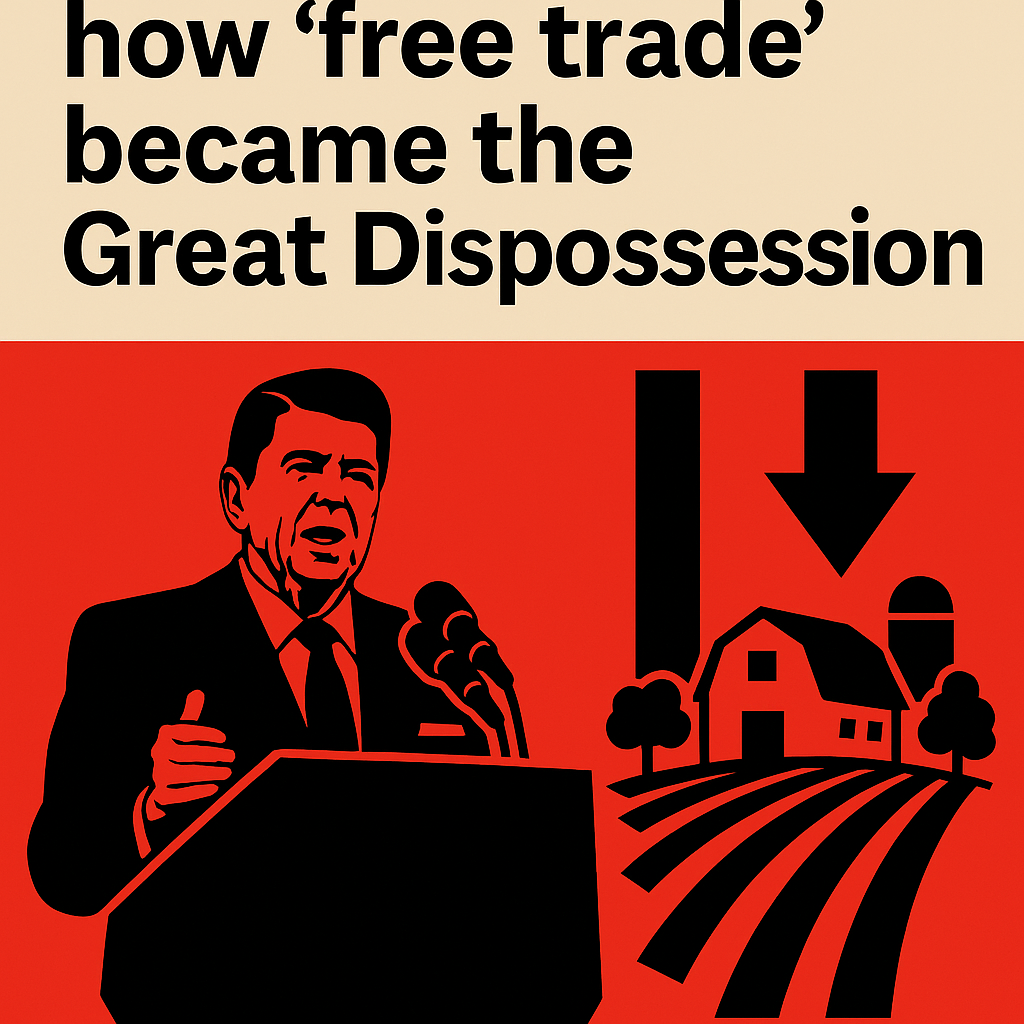
The short story. In 1987, President Reagan blessed “free trade” and Prime Minister Mulroney harmonized it here. But what actually rolled out was neoliberal mercantilism: rules that let capital outrun communities—“scale or die,” finance first, land treated as an asset class. Every party since has kept the hymn. The bill is now due at the grocery till, in the rent line, and on the land registry.
The receipts (Canada, recent):
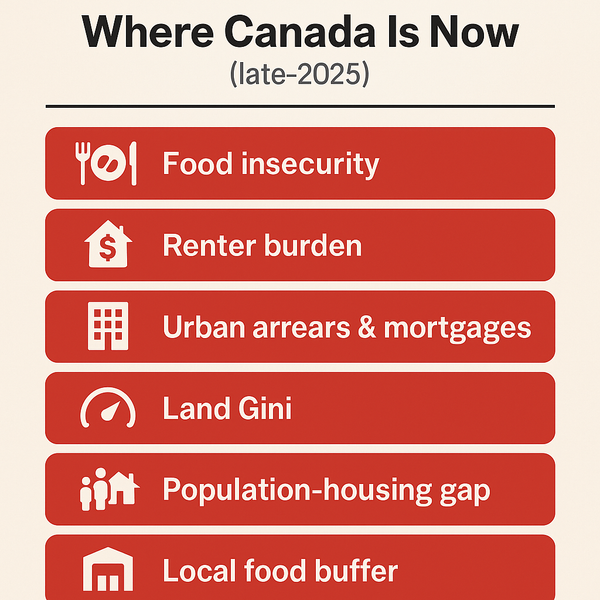
- Food insecurity: 25.5% of Canadians—≈10M people, incl. ~2.5M children—lived in food-insecure households (2024).
- Shelter stress: 22% spend ≥30% on shelter; rent arrears 7.8% nationally (19.6% Toronto); mortgage carrying cost 55% of pre-tax income nationwide (86% Toronto; 131% Vancouver).
- Costs to grow & move food: diesel ≈ $1.50/L; fertilizers still ~30% above benchmark; rents outpacing wages.
- Structural fragility: population +1M (2023) vs ~245k housing starts (2024); <1 week local calorie buffer in big metros; ~70% of titles in human names (slipping); land Gini ≈ 0.80 (severe concentration).
Where Limits to Growth meets your grocery bill
The Club of Rome warned that systems fail when they lose buffers, diversity, and feedback—that’s overshoot. We’ve done exactly that: thin food buffers, long just-in-time chains, concentrated ownership, and muffled local signals. Multiple updates to the original modeling suggest rising risk of economic/industrial slowdown within the next decade if we keep optimizing for throughput instead of resilience. In plain speech: the shelves, soils, and families won’t hold up to bigger shocks unless we change course.
Distributist analysis (what went wrong)
The reigning ideology treated place as a cost and people as inputs. But freedom begins with secure, family-scale access to productive land. When land, housing, and food are financialized, citizens become tenants of someone else’s spreadsheet. That’s the Great Dispossession.
Distributist response (what to build)
- Many owners, short supply lines, thick buffers.
- Trade that serves homes and towns, not homes and towns remade to serve bulk flows.
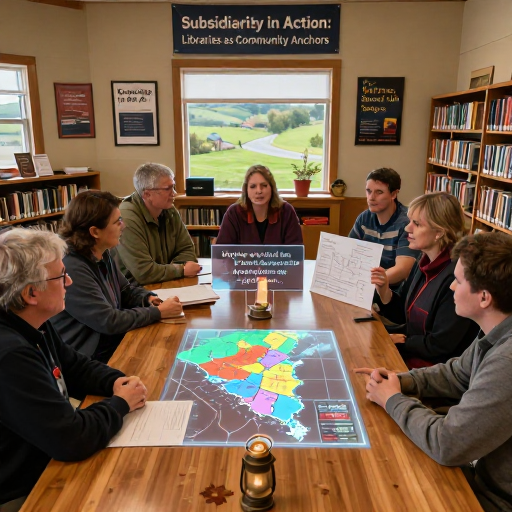
- Subsidiarity: decisions made close to the ground; higher levels coordinate, not command.
Practical illustration (how this looks on the street)
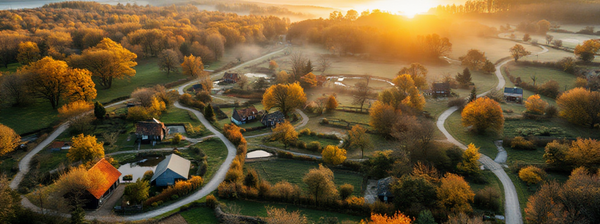
A county approves clusters of 1/3/6-hectare homestead severances near villages; titles are human-only (no numbered companies) with transparent beneficial owners; the hospital and school board commit to ≥30% local food; a parish guild co-op shares tools, seed, and a micro-processing hub; the credit union launches a Resilience Window for greenhouses, cold storage, and co-op equipment. In a shock, that county eats, works, and helps neighbours—without waiting on distant warehouses.
What Canadians can do now
Talk to reps (nonpartisan; copy-paste this ask)
- “Adopt a resilience dashboard.” Track: days of local calories, land-ownership Gini, % titles in human names, local procurement share, farmer median age, input-dependence ratios.
- “Restore wide ownership.” Human-only freehold + transparent registries.
- “Open the land.” Pilot homestead severances (1/3/6 ha) in every county.
- “Buy local on purpose.” Commit hospitals/schools to ≥30% regional food; preference for co-ops and worker-owned processors.
- “Right-to-grow bylaws.” Front-yard food, cottage-food rules, hens/bees, market-garden zoning, micro-abattoirs/processing.
Start the transition locally
- Form a Parish/Guild Food Co-op (bulk inputs, shared tools, seed/soil library, micro-processing).
- Land-share & adopt-an-acre: match land-rich/ time-poor with land-poor/ skill-rich neighbours via simple stewardship leases.
- Run a 21-day food-buffer challenge: community canning, grain buys, root-cellar projects until your town can ride a month of disruption.
- Ask your credit union for a Resilience Window: low-interest lines for greenhouses, cold storage, and co-op gear.
- Hold a quarterly Resilience Night at council to publish the dashboard and fix bottlenecks in public.
A friendly public message you can share (≈120 words)
In 1987 we were promised freedom through “free trade.” What we got was the Great Dispossession—record exports beside record food insecurity, families priced off land, and fragile supply lines. Canada now has one in four households food-insecure, thin local food buffers, and land ownership concentrating fast. Limits to Growth warned this would end in overshoot and contraction unless we rebuild buffers and ownership. Let’s make Canada hard to break: many owners, shorter supply lines, thicker local stores. Ask your reps for human-only land titles, homestead severances, resilience dashboards, and public procurement that favours local co-ops. We can still trade with the world—just not at the cost of our homes and dinner tables.
Reflective quotation:
“The most effective leverage is to change a system’s goal.” — Donella Meadows
What would this look like if every Canadian family had land enough to live freely and feed neighbours?