

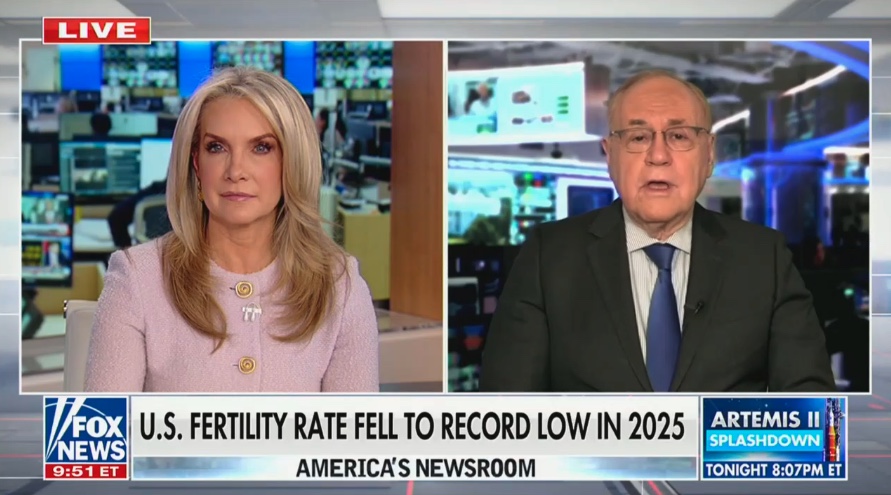
Fox News Senior Medical Analyst Marc Siegel made some eyebrow-raising comments lamenting that birth rates are down among teenagers aged 15 to 19.
On Thursday, the National Center for Health Statistics reported that the U.S. fertility rate fell to another record low. The agency reported that the number of births per 1,000 women of childbearing age declined from 53.8 in 2024 to 53.1 last year. The latest figure represents a continuation of a decades-long decline in fertility rates.
Siegel joined Friday’s edition of America’s Newsroom, where Dana Perino said that while the continuing trend is not surprising, “the numbers might feel a little shocking.”
I don’t think this is a real risk. And if it were, it certainly won’t be anytime soon. Fewer people means fewer mouths to feed, fewer homes to build/maintain and less consumption in general, which given how the planet is struggling to continue balance with current human resource consumption, a gradual decline in human population would probably be beneficial in the long run.
To actually threaten humanity’s continued existence the number of humans would need to dwindle so low that the societial and the medical infrastructure that permits/causes the declining birth rates would completely collapse and people would naturally start having more kids again in order to keep up with the work on the farms that most people would need to work on at that scale of society
Edit: Put more susinctly, the current declining birth rates are a because of societal changes, not biological ones
Agreed. I think globally we are still above replacement rate.
Yes, but no. As the video I linked points out, because of the time delay you get fewer people with maximum productivity while still needed to support people that have sub-self-sustaining productivity. Eventually, you might get to a smaller population that choose to return to above replacement rate, but the demographic squeeze don’t got away for another 20-30 years. Once it starts you are stuck in a demographic squeeze, it makes it even harder on everyone, making that choice “harder”.
That is a simplification. Sub-self-sustaining productivity doesn’t exactly track with age, and how much it takes to sustain a joyful life varies based on a lot of factors; it sort of tracks downward but can also go up if economies of scale shirk or when a new essential utility is introduced by technology.